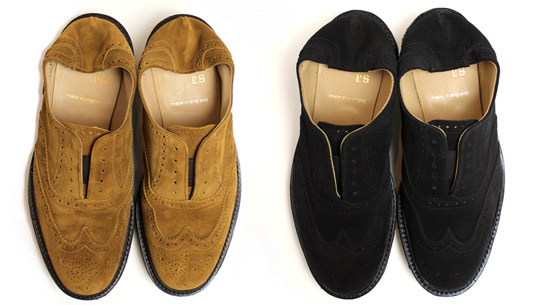
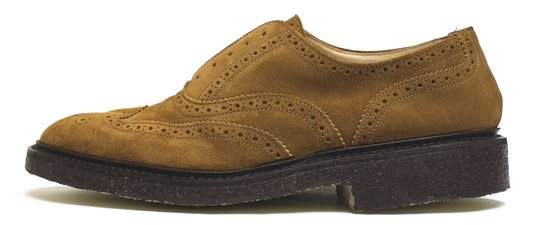
I just came across some interesting pairs of Tricker’s on Starling where the laces have been replaced with elastic. It also does not look like they added heel counters, allowing for some flexibility in the back of the shoe for ease in putting them on. They probably would have looked much better with single leather soles though.
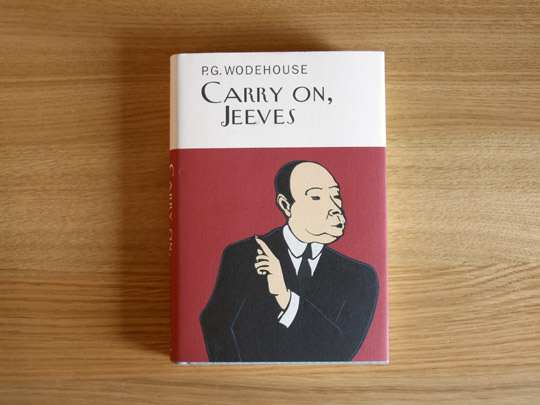
P.G. Wodehouse, the original literature humorist (as far as I’m concerned). Among his large collection of stories, the ones which feature the character of Jeeves are my favorite. Some excerpts from the first chapter…
On inappropriate dinner atire:
‘I was at one time in Lord Worplesdon’s employment. I tendered my resignation because I could not see eye to eye with his lordship in his desire to dine in dress trousers, a flannel shirt, and a shooting coat.’
On polishing shoes:
‘I beg your pardon, sire. I was endeavoring to find you.’
‘What’s the matter?’
‘I felt that I should tell you, sir, that somebody has been putting black polish on our brown walking shoes.’
‘What! Who? Why?’
‘I could not say, sir.’
‘Can anything be done with them?’
‘Nothing, sir.’
‘Damn!’
‘Very good, sir.’
On the topic of an awful looking suit:
‘Oh, Jeeves,’ I said; ‘about that check suit.’
‘Yes, sir?’
‘Is it really a frost?’
‘A triffle too bizarre, sir, in my opinion.’
‘But lots of fellows have asked me who my tailor is.’
‘Doubtless in order to avoid him, sir.’
‘He’s supposed to be one of the best men in London.’
‘I am saying nothing against his moral character, sir.’
‘All right, Jeeves,’ I said. ‘You know! Give the bally thing away to somebody!’
‘Thank you, sir. I gave it to the under-gardener last night. A little more tea, sir?’
Some of the stories were also adapted into an excellent TV series, simply named “Jeeves and Wooster.” A previous post on the show: Jeeves Disapproves
Serve over ice in Duralex glassware and garnish with a lemon slice.
Death in the Afternoon
2oz Absinthe
Cheap Champagne
Or as Hemingway put it: “Pour one jigger absinthe into a Champagne glass. Add iced Champagne until it attains the proper opalescent milkiness. Drink three to five of these slowly.”
No Olive Martini
2oz Gin
0.5oz Dry Vermouth
Shake with ice in a mixer and serve in a martini glass with a lemon peel garnish.
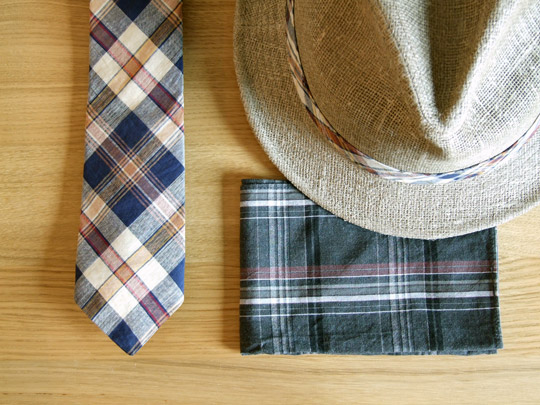
A vintage Paul Stuart tie with a linen fedora and pocket square from Engineered Garments. When I have the time later, I’ll take a few more shots of the tie which has an exceptionally thick lining – they sure don’t make them like this anymore.
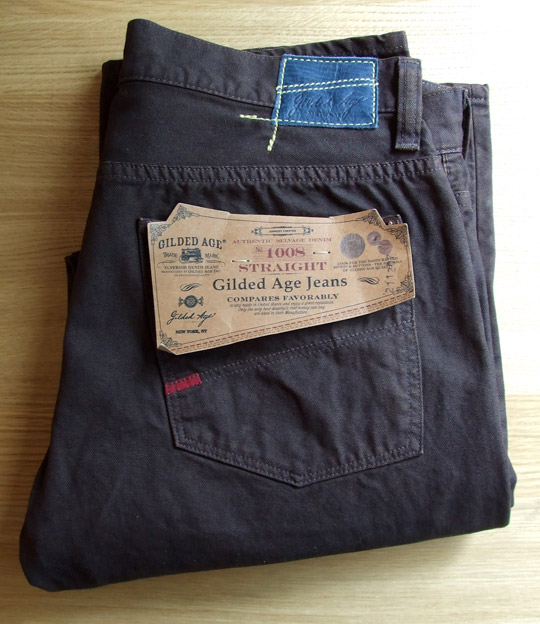
New sale find: brown dyed 1008 straight leg jeans from Gilded Age. Made in Japan, the fabric is very interesting and is already fading on some edges around the pockets and seams.
Despite some really great workmanship, Gilded Age doesn’t get much attention by anyone as its products are usually very expensive and retail distribution has not been well thought out. Further muddling up the consumer perception, they also made the odd decision of splitting up their origins of manufacturer – some products are made in Japan, but the rest in China. While Ralph Lauren’s RRL could get away with something like this, a small boutique brand cannot.
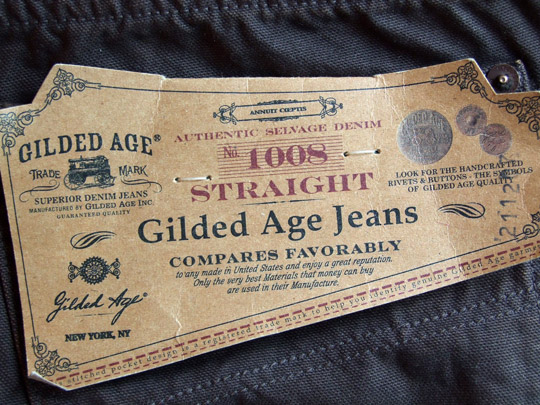
Marketing is also off. From the label attached to my jeans: “Compares favorably to any made in United States and enjoy a great reputation. Only the very best materials that money can buy are used in their manufacture.”
This strikes me as bad way to sell your brand, especially when you’re selling luxury goods – there is not much for high end denim that is produced here in the United States anymore and the statement above makes it sound like the jeans are only second best.
I am very happy with this particular pair though, and look forward to how the fading on these might turn out in a year or so from now. Read more
A classic film, in many ways: “To Catch a Thief is a 1955 romantic thriller directed by Alfred Hitchcock and starring Cary Grant, Grace Kelly, Jessie Royce Landis and John Williams. The movie is set on the French Riviera, and was based on the 1952 novel of the same name by David F. Dodge.”
In some of the earlier scenes, Grant is wearing a pullover and handkerchief – this was a last minute wardrobe change that was done after Hitchcock learned that the button down collar shirts Grant was wearing did not exist in France during the time period the movie was set in.
Over the past year, many film groups around the world have been celebrating the centennial of Akira Kurosawa’s birth – check with your local indie theaters to see if they have anything planned. From the Berkeley Art Museum:
Born in 1910 in a Japan just emerging from its isolation, Kurosawa studied painting and literature, especially Dostoevsky and Gorky; after the suicide of his influential older brother in 1933, he abandoned his art career and entered filmmaking, ascending from the lower rungs of Toho Studios to become one of Japan’s, and the world’s, most important directors. His rise to prominence in the 1950s coincided with (and helped create) the rise of the “art film,” but that label only obscures his many styles and talents. He adapted Shakespeare, Russian novels, and American detective stories, ancient Japanese plays and contemporary Tokyo tales; and worked in every genre from crime dramas to samurai films, large-scale feudal epics to intimate character pieces. All his films were united by an embrace of ordinary humanity and heroism (and, in many cases, laughter), the heroism not of fighting or conquest, but of devoting oneself to a greater good, and achieving it.
If you’ve not seen any of his films before, I would suggest starting with Yojimbo and Ikiru.
NOWNESS has a nice feature on Piaget today, with photography from Douglas Friedman and a short story by Bret Easton Ellis. It’s interesting to see that their factory workspace looks very much like a scientific laboratory.
Though Piaget is one of many watchmakers to have sprung from the Swiss Alps, it has a unique place within the history of horology: since 1957 (when it produced the 2mm-thick Calibre 9P) the brand has been famed for its super-slim watch movements, a tradition carried to this day in recent models such as the Calibre 600P (at 3.5mm, the thinnest tourbillon movement in the world). But this is not Piaget’s only innovation: due to the lightness and slimness of its designs the company became one of the earliest to transform the watch into a fully-fledged fashion accessory in the 60s, when Piaget placed miniature clock faces (in lapis, azul, turquoise and tiger’s eye) in a range of increasingly extravagant rings, cuffs, cufflinks and necklaces.